

My husband and I stepped onto the high-speed train bound for Huangshan at Shanghai Train Station. After settling into my seat, I immediately noticed a white guy sitting across the aisle from me. This was the spring of 2024; westerners still hadn’t returned after the “great exodus”—first due to COVID, and then the escalating geopolitics between China and the U.S.—and this lone “foreign ghost” caught my attention. Soon after we pulled out of the station, the train attendant came to distribute water bottles and snacks. What I heard from the only foreigner on the train piqued my curiosity: he politely requested an extra bottle of water instead of the snack, in perfect Mandarin.
“Where are you from?” I leaned forward, placing myself in this guy’s line of sight, and asked in Chinese, with maybe a bit too much enthusiasm.
“Oh, I, eh, I live in Shanghai.” I detected a slight hesitation before he answered.
“Your Chinese is so good!” I was excited about a Westerner speaking Chinese, in China. “So, where are you from?” I switched to English—I wasn’t used to speaking Chinese to non-Chinese.
“I am Italian.” The guy answered in Chinese.
“Oh wow! How many years have you been in China?”
“Seven.”
I carried on with my line of questions, but the train had soon slowed down to pull into its first short stop on the route.
“This is my stop.” The Italian guy looked a bit relieved. “I work here,” he quickly added, before starting to stand up and grab his backpack from the luggage rack.
*
In Chinese, 您是哪儿人?would be the equivalent of Where are you from? but mostly means Where is your family from? We don’t care where you were born, where you lived or are living, but where your ancestors were. The answer to Where are you from confirms the place of your origin, the place where your roots are, the place where you belong.
“Where are you from?” was a simple and unambiguous question in my first few years in America. “I am from China,” I’d answer, without giving it too much thought.
I can’t tell when ambiguity started to arise.
*
Ambiguity didn’t arrive all at once.
Maybe it was after I moved from Nebraska, the first state I lived in, in America. “You mean, where I lived before,” I added, “or where I was from originally?”
Maybe it was much later, when “Where are you from” started to imply less about the places lived, but more about identity.
A couple of years ago, I was invited to a neighbor’s house for a family event. We live in a gated community with mostly five-acre lots; residents here usually keep to themselves on their own property. At the time, I had lived there for eight years and had hardly met more than a quarter of the neighbors, so this was a rare opportunity to mingle.
The Where are you from question came up not long after I joined the friendly chit-chat. By that point, I had lived in the States for more than thirty years; I had learned that it was always easier—on myself and the questioner—not to take offense. A simple “I am originally from China” would often be satisfactory. But once in a while, like in this instance, it fell short. I was then asked how old I was when I came. I said twenty-three.
“Oh, then you really are a Chinese!”
I didn’t quite know how to respond to that, so I said nothing.
I have been a U.S. citizen for many more years than I was a Chinese citizen. There are still aspects of me that land squarely in the “foreigner” category—my looks, my accent, even my demeanor. Maybe it doesn’t really matter how many years I have been “assimilating”; I will always be somewhat foreign, in a country where the majority of its people don’t look, sound, or think like me.

*
My father-in-law was a colonel in the Republic of China Army. In 1948, as the Chinese Nationalist government retreated to the island of Taiwan, he took his family and left the mainland, where they were from.
My husband was born and raised in Taiwan—in a military dependents’ village, 眷村, to be more specific. Yet in the twenty-eight years he lived there, he was always labeled 外省人—outside-province person—by the locals; he never truly felt he belonged outside of the village. When he later came to America, he became 外国人, a foreigner. On the trips when he accompanied me to mainland China, he was referred to as my Taiwanese husband.
One day, he announced stoically that he no longer knew where he was from, or where he belonged. “I am always going to be an outsider, wherever I go.” There was sadness in his voice, and more than that, reckoning.
*
My mother was the reason that I came to America—to study, to live, and to make it my new home. She came, too, after retirement: she studied English, worked as a music teacher, performed concerts, and became a citizen. She finally lived the life she had always wanted. But in the last couple of years of her life, she made my sister and me promise to take her ashes back to Shanghai, to be buried with her family. Because that was home to her; that was where she belonged; that was where she was from.
And so I ask myself, what’s my answer to Where are you from? Where would I want to be buried—or my ashes scattered—when it’s my time?
*
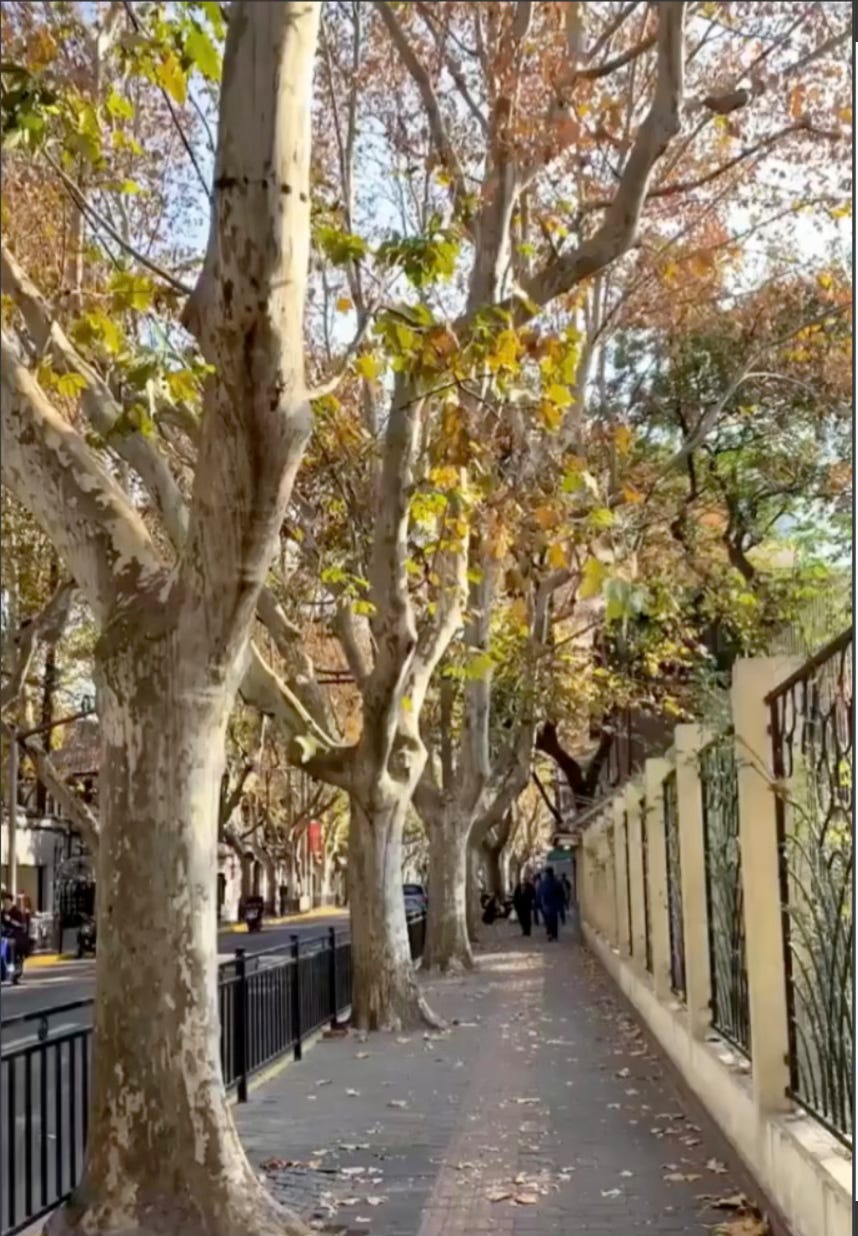
We left Huangshan and continued our trip to Tianjin. Our hired driver came to pick us up at the Tianjin train station. It was only minutes after we got in his car that he asked, “Where are you from?” Like that Italian gentleman we met on the train, I hesitated before answering. “Um, we just came from Huangshan, and we live in America.” Then I thought for a few seconds and added, “I am from Shanghai.”
Like what you read? It would make my day if you let me know by clicking the ❤️ below, and feel free to share with your friends.
To read more stories from The Dreams of an Immigrant, check out here, and browse the website to read my other essays.
Subscribe to receive future newsletters in your email inbox. You can unsubscribe at any time.
Thanks for sharing this piece. It's fascinating how the question of home/origin sounds in different phases of life, and different places you live and travel. And “I am always going to be an outsider, wherever I go.” hit me hard.
this is really beautiful. such a complex question in these times. it reminds me of a beautiful writing prompt a poetry teacher once offered: writing where you are “from” in the way that’s truest to you.
example: i’m from summers where it never got above 90 and lakes whose bottoms are muck that clings to your toes and roadside blackberries that turn your whole face purple.
it’s a fun exercise to explore what we’re actually choosing to carry forward in our lives.
thanks for sharing you and your husband’s experiences.