

If you are like me, you probably wouldn’t think about temples when visiting Shanghai. But right in the middle of dense urban areas, maybe on one of your DiDi (Chinese Uber) rides, you catch a glimpse of an ancient temple squeezed between gleaming skyscrapers, and you marvel at the dichotomy.
There are several temples in the greater Shanghai metropolis: the Jing’an Temple, Jade Buddha Temple, City God Temple, and Longhua Temple, just to name a few. Blending ancient lineage and futuristic modernization, these temples are more than tourist stops. They offer a reflection on thousands of years of history; their presence creates a jarring, surreal, and oddly beautiful coexistence.
Longhua Temple, 龙华寺, is the oldest and largest temple in Shanghai, with a history of over 1,780 years. It was built during the Three Kingdoms 三国 period under the rule of Eastern Wu 东吴 (222-280 CE). The name Longhua originates from a Buddhist scripture, with the tale of the Maitreya Buddha attaining enlightenment under a Longhua tree. Longhua literally translates to “Dragon Flower.” It refers to a specific sacred tree in Buddhist eschatology, but what you will find in Longhua today are commonly known as peach trees.
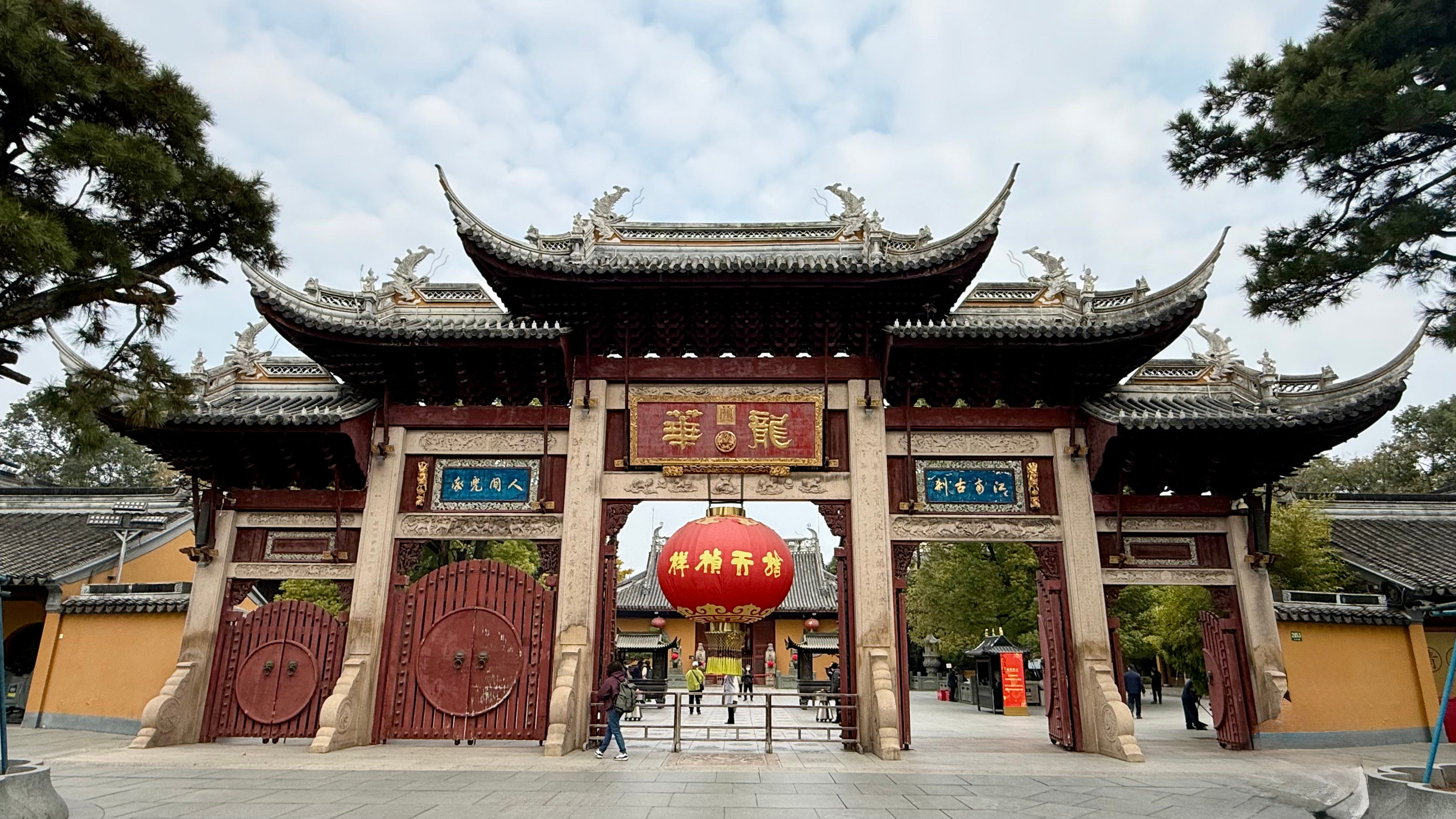
When I lived in Shanghai in the 1970s and 80s, the thought of visiting Longhua Temple never occurred—there wasn’t much left to see after the destruction of the Cultural Revolution, and the name’s connection to the nearby Longhua Crematorium, Shanghai’s only funeral parlor, cast a heavy shadow on the psyche of my generation.
But times have changed. During my recent visit to Shanghai, the topic of visiting the temple came up in a dinner table conversation.
“You have never visited Longhua Temple? You really should!”
“There is so much to see, and you will surely find it interesting—the visit is not just about seeing a temple.”
“Oh, and many cute cats are roaming on the temple grounds!”
The word “cats” in that last sentence sealed the deal. Both my husband and I love cats, and since NiuNiu walked into our yard—and our heart—three years ago, we have become devoted cat parents and are drawn to anything and everything about cats.
We decided to carve out half a day to visit Longhua Temple—this from a trip already cut short by NiuNiu’s care needs back home.
***
November weather in Shanghai can be a bit hit and miss. Just a day earlier, I regretted wearing my winter coat, but on the morning of our visit to Longhua Temple, it’s windy and chilly, and the sun’s warmth is barely noticeable. I hug my down coat tight and follow the instructions blasted from the loudspeaker to the entrance of the temple. It’s Wednesday; the crowd is thin.
Stepping through the high wooden threshold of Longhua Temple, the energy shifts. The world inside the walls is suddenly different from the city we just came from—the sound, the smell, and the sight—and we enter an island of “slow” in a relentlessly “fast” city.
The first sight to greet us is the 40-meter (~133 feet) tall Longhua Pagoda standing in the center of the temple courtyard.
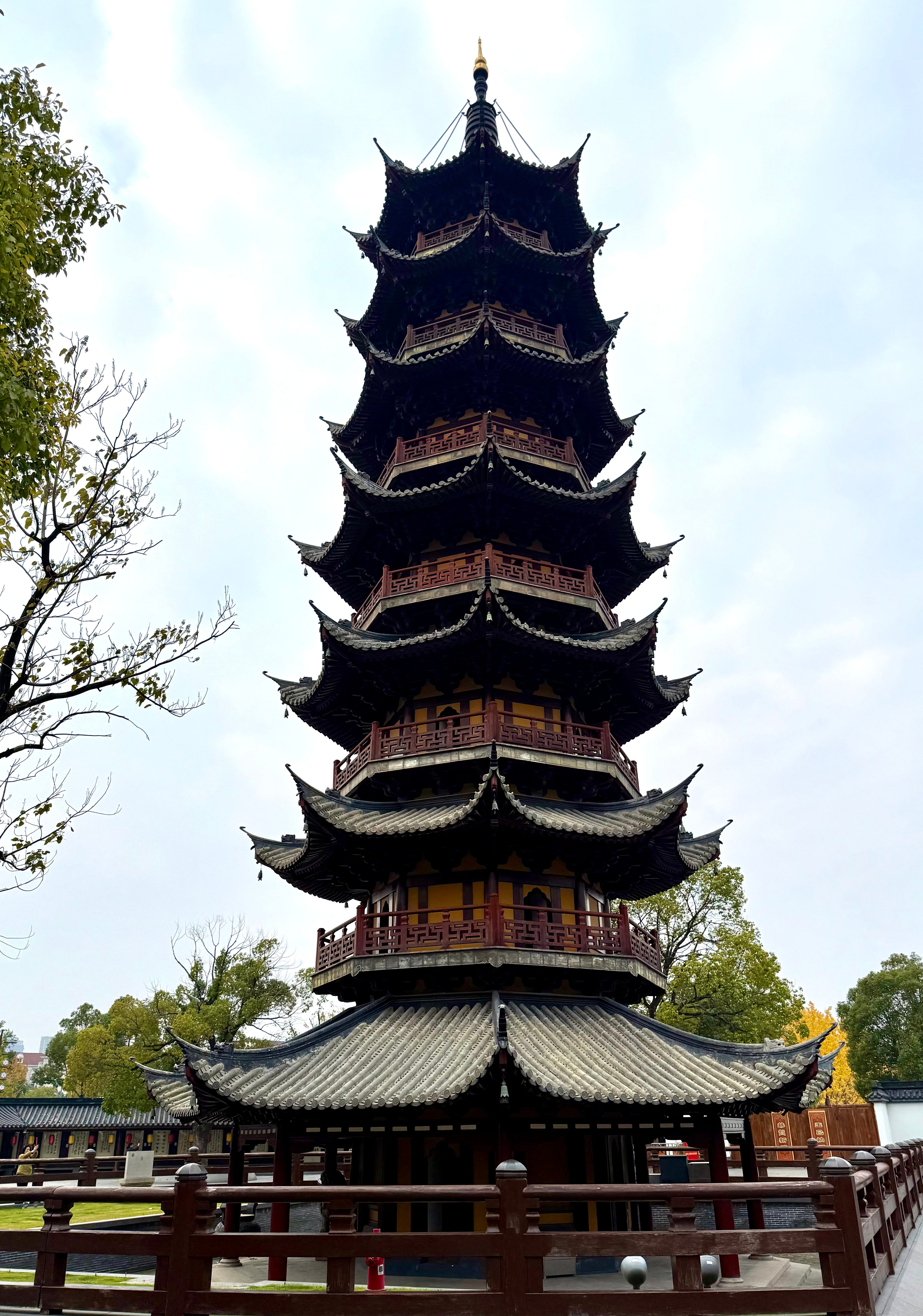
The pagoda was originally built in 242 CE to house one of the 13 Śarīra, also known as sacred relics (cremated remains of the Buddha). It was later destroyed, together with the temple, during the wars of the Tang Dynasty (618-907 CE). The core of the pagoda we see today was rebuilt in the Song Dynasty (960-1279) in 977 CE, the same as the temple’s classic Song period Five-Hall layout (五山十刹). Both the temple and pagoda have sustained repeated destruction from thousands of years of cyclical civil wars and the Japanese invasion during WWII (1937-1945). Most recently, in 1966, the peak of the Cultural Revolution destruction period, almost all the Buddha statues and religious artifacts were destroyed, and thousands of volumes of ancient scriptures were burned. When a group of Red Guards arrived with firewood and gasoline ready to burn the “symbol of feudal superstition”—the pagoda—down to the ground, students and teachers from a local school rushed to the scene. In an act of defiance and bravery, they held hands to form a physical circle around the Pagoda while arguing that the architecture was a Cultural Relic, Wenwu (文物), and was protected by the State Council. Faced with the growing crowd of determined protectors, the would-be arsonists eventually gave up and retreated.
Today, the thousand-year-old Pagoda stands in the temple courtyard, a solemn witness to history, both a protector of the relic and a relic in itself. We stand in front of it, imagining the ancient core beyond the post-1980 restoration of the façade, and that somewhere deep inside it, there is a crypt containing the legendary relic. It’s surreal.
Worshippers come to pay respect every day. They circle the Pagoda, holding burning incense with both of their hands, silently reciting prayers for blessings.
And just then, there appears the first Longhua cat, a white-toed tabby. He pauses to study my stare, then resumes the chase, wasting no time. I suppose this is a game he plays often with the resident pigeons.
His appearance instantly adds secular liveliness to the otherwise reverent ceremonial focus.


(Can you hear the chanting in the background?)
***
The phenomenon of the Longhua cats started during the strict Shanghai COVID lockdowns. The city’s stray population faced a crisis when their usual food sources—outdoor diners and local residents—disappeared from the streets. Longhua Temple became a sanctuary for these animals. The temple was closed to the public, but the monks and staff, practicing the Buddhist principle of Ahimsa (non-harming) and “Life Release,” started providing food and shelter for the strays, allowing them to roam freely through the sacred halls. As the lockdowns continued, these Longhua cats became more than residents of the temple; they became a form of quiet resilience.
Among the original resident cats, several have “risen to fame” with legendary tales and benevolent names bestowed upon them. Some even have their photos professionally taken and displayed in a side hall.


One of them has a story worthy of being enshrined in legend. At the beginning of the pandemic, a mother cat had a litter of newborn kittens in the streets. A pack of hungry strays attacked her family and killed all her babies. When the cats later took refuge inside the temple, the implacable mother hunted down her attackers one by one and killed all of them. No one at the temple can match the story to the photos on display, but I don’t need a photo; confirmation is not needed. The image of a courageous mother cat in mourning has already lodged in my mind.
***
These Longhua cats are not pets, but “sentient beings seeking the way.” In the silence of the empty temple, the bond between the monks and the cats is strengthened, and the cats calmly wandering among the ancient architecture become a symbol of the city’s recovery and a reminder of the temple’s role as a place of refuge for all living beings, regardless of the chaos in the human world. The pandemic ended, and the cats stayed.
Inside the temple, I find them everywhere I look.
One is seen lounging on the ancient steps of the Grand Hall while the monks chanted sutras inside as if he were listening, or maybe chanting in silence. A large torbie is chilling nearby when a “meow” breaks the chanting, and an orange tabby leads my husband to the water tap—the cat is asking for someone to turn on the faucet! The water station is set low on the step; I’d like to believe it was thoughtfully installed by the monks, just for these resident cats.
Some wander by the snack shop, or sit quietly with their eyes closed; one perches on the wall, looking down with piercing caution. They are mellow, or even indifferent, but expectant. Are we, the visitors, a nuisance to them or dependable caregivers?


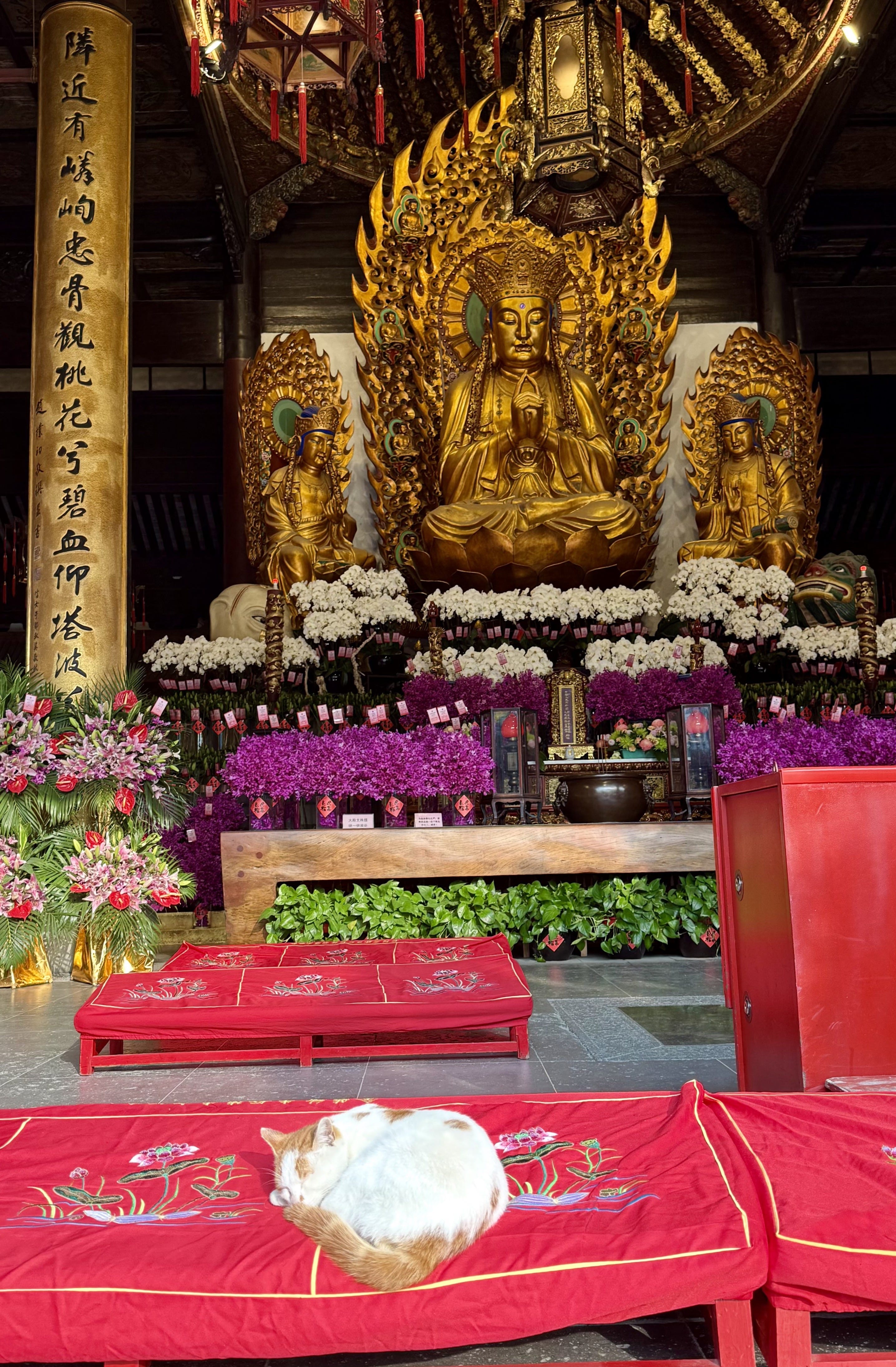
This one is napping on a prayer mat next to worshipers offering incense. Is it the sun’s warmth she is after, or the softness of the cushion?
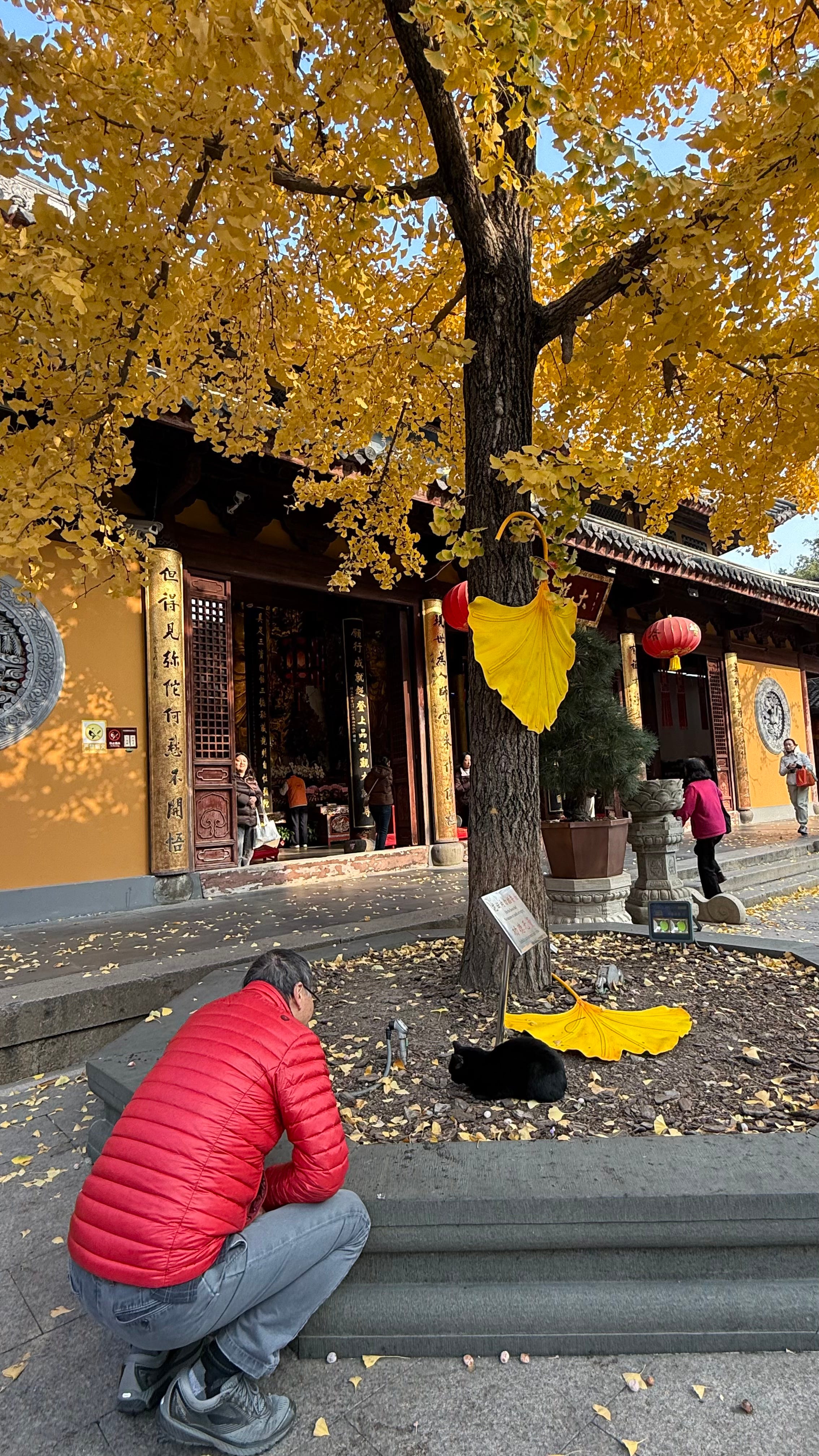
Under the 1,000-year-old ginkgo trees, a black cat is meditating. The golden leaves are falling in the chilly November wind. My husband kneels close to the cat, “Are you cold?” He is thinking about his NiuNiu, also black, alone at home. We left two space heaters on to keep her warm while we are away.
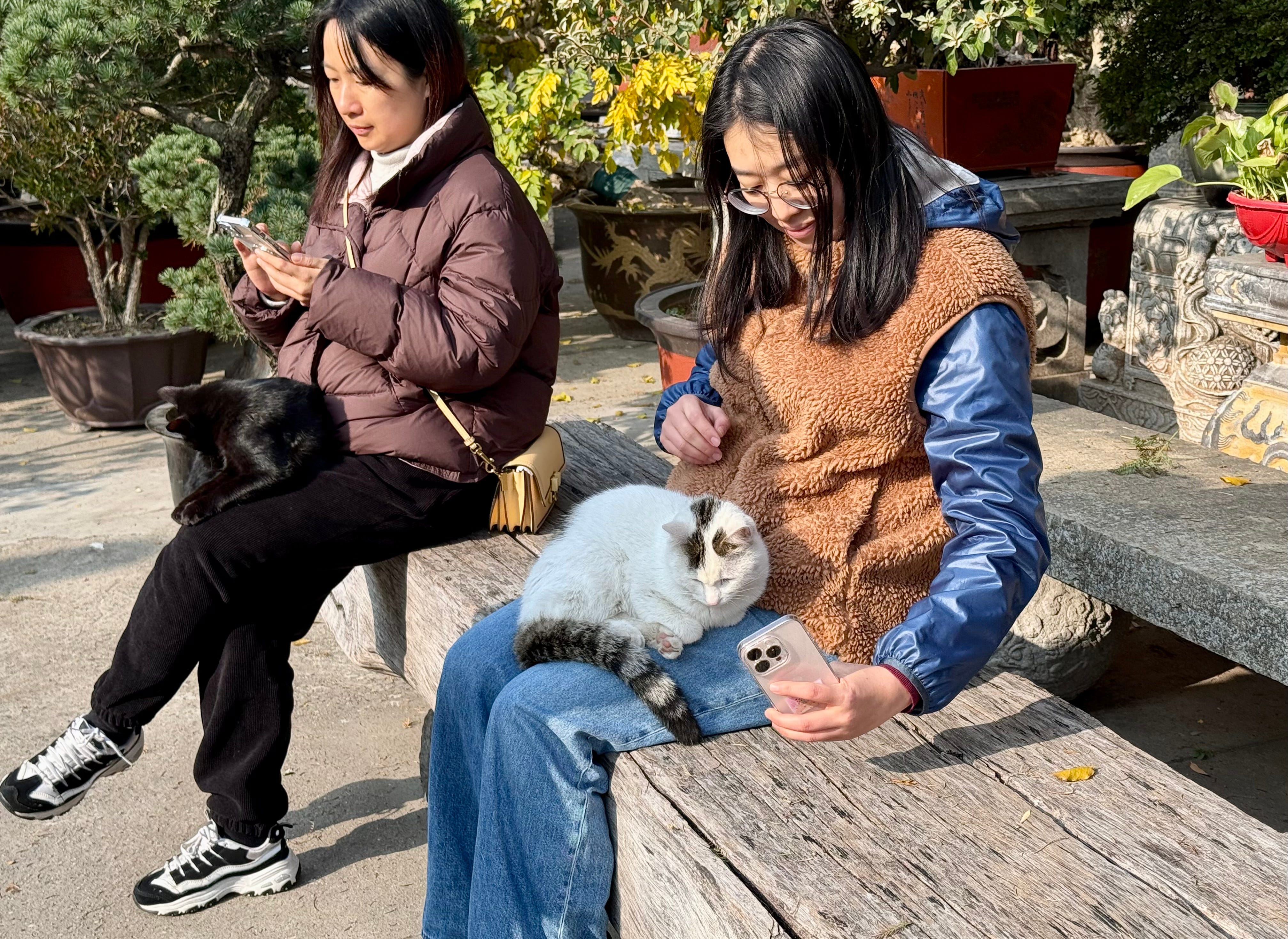
We walk through the quieter side gardens on the way out. Early afternoon sun warms the air and the benches surrounded by bonzai pots. This is an ideal resting spot for visitors. Several cats, more trusting than the others, take this opportunity to make themselves cozy on visitors’ laps. I wonder which one is seeking the companionship. I don’t have the answer, but I find this scene consoling.
***
Many say that there is a “Zen Master” energy about the Longhua cats. Behind the calm and indifferent veneer, I see scars of survival—and with them, a quiet acceptance. If entering Longhua Temple is like stepping into a time capsule spanning over a millennium, meeting the Longhua cats reminds me that our worlds are connected; we need each other; and we are all sentient beings seeking the way.
Some believe these cats are the “reincarnated guardians” of the temple, just as the Pagoda is the protector of the relic. Who is to say that humans—if we choose to—are not the real protectors after all?
The temple and the cats share a spirit of endurance, and visitors come to find the spirit that they seek. My husband and I came here for the cats. We found something more.
🐈⬛🐈⬛🐈⬛
Like what you read? It would make my day if you let me know by clicking the ❤️ below, and feel free to share with your friends.
To read more stories from The Dreams of an Immigrant, check out here, and browse the website to read my other essays.
Subscribe to receive future newsletters in your email inbox. You can unsubscribe at any time.
I loved this glimpse into a side of Shanghai so different from the glittering modern cityscape.
Omg the photos of the cats!!!🥰 and the mother cat story is just powerful! Looks like a great spot to visit when I go to Shanghai again.